Johnson County Dog Registration Information
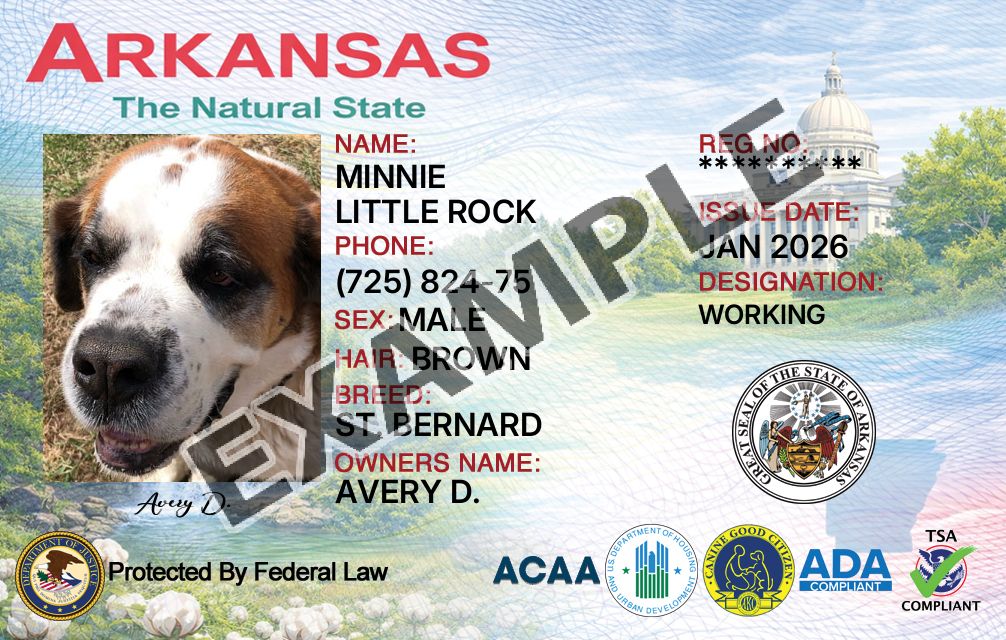
Service Dogs and Emotional Support Animals in Johnson, Arkansas
If you’re searching where do I register my dog in Johnson County, Arkansas for my service dog or emotional support dog, the key thing to know is that “registration” usually means different things depending on your goal: a local dog license in Johnson County, Arkansas (often tied to rabies compliance and local ordinances), versus a dog’s service dog legal status under federal law, versus documentation used for an emotional support animal in housing.
In most communities, an animal control dog license Johnson County, Arkansas is handled locally (city offices, animal control, or sometimes law enforcement) and is separate from whether your dog is a service dog or an ESA. This page explains where to register a dog in Johnson County, Arkansas using official local offices as examples, what to bring, and how rabies vaccination enforcement typically fits into licensing.
Where to Register or License Your Dog in Johnson County, Arkansas
Because dog licensing and animal control are commonly handled at the local (city or county) level, start with the office that covers where you live (inside city limits vs. unincorporated county areas). Below are example official offices within Johnson County, Arkansas that residents commonly contact for animal control, local ordinances, and rabies-related enforcement questions.
Clarksville Animal Control (City of Clarksville, AR)
Address: 802 W Lucas St
City/State/ZIP: Clarksville, AR 72830
Phone: 479-440-0961 (Animal Control Officer)
Phone: 479-774-6911 (Clarksville Police Department, animal control assistance)
Office hours: Not listed
Clarksville City Hall (City of Clarksville, AR)
Address: 205 Walnut Street
City/State/ZIP: Clarksville, AR 72830
Phone: 479-754-6486
Office hours: Mon–Fri 8:00 AM–12:00 PM, 1:00 PM–4:30 PM
Johnson County Sheriff’s Office (Johnson County, AR)
Address: 301 Porter Industrial Rd
City/State/ZIP: Clarksville, AR 72830
Phone: Not listed on the referenced official pages
Johnson County Health Unit – Clarksville (Arkansas Department of Health)
Address: 6 Professional Park Dr
City/State/ZIP: Clarksville, AR 72830
Phone: 479-754-2949
Overview of Dog Licensing in Johnson County, Arkansas
What “dog licensing” usually means
A dog license in Johnson County, Arkansas typically refers to a local permit or tag process administered by a city (or, in some places, the county). While specifics can vary by jurisdiction, local licensing programs often exist to: track ownership, encourage vaccination compliance, support animal control operations, and help reunite lost dogs with owners.
Licensing is local (city-by-city and sometimes countywide)
Johnson County includes multiple communities, and animal ordinances can differ depending on whether you live in a city like Clarksville or in an unincorporated area. That’s why the most accurate answer to where to register a dog in Johnson County, Arkansas is usually: contact your local city hall/animal control first, and if you’re outside city limits, contact the county-level agency that handles animal control and nuisance enforcement.
Rabies vaccination requirements (statewide rule that affects local licensing)
Arkansas law requires dogs and cats to be vaccinated against rabies by four months of age. In practice, many local licensing systems require proof of current rabies vaccination before issuing a tag (or they may enforce rabies requirements through animal control and bite investigations). Keep your rabies certificate in a safe place and consider carrying a copy when traveling with your dog.
How Dog Licensing Works Locally in Johnson County, Arkansas
Step 1: Identify your jurisdiction (city limits vs. county)
Before you try to license your dog, determine whether you live inside a city’s boundaries (for example, inside Clarksville city limits) or in an unincorporated part of Johnson County. This matters because your local animal control program or city hall may be the office that answers “animal control dog license Johnson County, Arkansas” questions for your specific address.
Step 2: Ask what the local process is (tag, registration, or proof-of-vaccination requirement)
Not every Arkansas community uses the same terminology. Some places sell annual tags at city hall. Others mainly enforce rabies compliance and leash laws without issuing tags in the same way. When you call, ask:
- Do you issue a dog license/tag? If yes, is it annual and what are the fees?
- What proof is required (rabies certificate, ID, residency)?
- Is there a different process for dogs kept inside city limits vs. outside?
- If my dog is a service dog or ESA, do I still need a local dog license or rabies vaccination proof?
Step 3: Bring documentation and keep copies
Even if the office doesn’t require everything listed below, having it ready can save a second trip. Local offices often need to confirm rabies vaccination and owner identity. If you are moving into Johnson County, Arkansas, it’s also helpful to bring something that shows your local address.
Step 4: Understand enforcement (rabies, bites, and at-large complaints)
Local animal control and law enforcement typically handle complaints such as dogs running at large, nuisance behavior, and bite reports. Rabies rules are especially important in bite situations, where proof of current vaccination can affect quarantine and follow-up requirements. If you’re unsure how your area handles these cases, the city animal control contact (if you’re inside a city) or the county sheriff’s office (for unincorporated areas) is often the best starting point.
Service Dog Laws in Johnson County, Arkansas
Service dog status is based on training and disability-related work, not a registry
A service dog is generally a dog that is individually trained to do work or perform tasks for a person with a disability. The legal status comes from the dog’s role and training, not from purchasing an online certificate or joining a database. In other words, there typically isn’t a county “service dog registration” that creates service dog rights.
A local dog license is still a local requirement
Even if your dog is a service dog, local public health rules (like rabies vaccination requirements) still apply. If your city requires a dog tag or local license, a service dog may still need the same local licensing as other dogs. The difference is that a local license is about compliance with local animal rules—not about granting public access rights.
Public access: what businesses can (and can’t) require
While businesses and staff may have limited questions they can ask to confirm a service animal, they generally cannot require you to show an ID card from an online registry. That said, service animals must still behave appropriately in public and comply with local health rules (including vaccination requirements). If you run into conflicting information, focus on the practical separation:
- Service dog legal status: based on disability-related tasks and training.
- Dog license in Johnson County, Arkansas: a local compliance issue (if required by your city/county).
- Rabies vaccination: a public health requirement that applies broadly.
Emotional Support Animal Rules in Johnson County, Arkansas
ESAs are not the same as service dogs
Emotional support animals (ESAs) provide comfort by their presence, but they are not trained to perform specific disability-related tasks in the same way service dogs are. ESAs generally do not have the same public access rights as service dogs in stores and restaurants. That difference often leads people to search for “ESA registration,” but many “registrations” sold online are not required by law.
Housing is where ESA documentation is most commonly used
ESA status most often comes up in the housing context. A housing provider may request reliable information supporting the need for an assistance animal as part of an accommodation request. This is separate from local requirements like a dog license in Johnson County, Arkansas or rabies vaccination compliance.
Local licensing and rabies requirements still apply to ESAs
Even if your dog is an ESA, local animal rules still apply. If your city issues dog tags or requires licensing, your ESA may still need to be licensed the same way as other dogs in that jurisdiction. Likewise, rabies vaccination requirements apply regardless of whether the dog is a pet, a service dog, or an ESA.
Frequently Asked Questions
Service dog rights generally do not come from a county registry. However, your dog may still need to comply with local requirements such as a dog license in Johnson County, Arkansas (if your city issues licenses/tags) and statewide rabies vaccination rules. If you want the most accurate answer for your address, call your city’s animal control/city hall (or the county agency responsible for animal control in unincorporated areas).
If you live inside Clarksville city limits, start with Clarksville Animal Control or Clarksville City Hall listed above. They can tell you whether the city issues tags/licenses and what proof is needed. This is often the most direct path when people search where to register a dog in Johnson County, Arkansas and they’re located in Clarksville.
Yes. Arkansas requires rabies vaccination for dogs and cats, and local licensing (where offered) often relies on proof of current rabies vaccination. Even if your area does not issue a formal license tag, rabies proof can be important for animal control enforcement and bite-related procedures.
Usually, no. ESA status is typically used in housing accommodation requests, not public access, and not as a substitute for a local dog license. If your city requires a dog tag/license, an ESA generally follows the same local rules as other dogs (plus rabies vaccination requirements).
In unincorporated areas, responsibilities can differ by county. For Johnson County, Arkansas residents outside city limits, the county sheriff’s office is a practical place to ask who handles animal control, at-large dogs, nuisance complaints, and rabies-related enforcement for your area.
Register A Dog In Other Arkansas Counties
Select your county below to get started with your dog’s ID card. Requirements and license designs may vary by county, so choose your location to see the correct options and complete your pup’s registration.
- Arkansas County Dog Registration
- Ashley County Dog Registration
- Baxter County Dog Registration
- Benton County Dog Registration
- Boone County Dog Registration
- Bradley County Dog Registration
- Calhoun County Dog Registration
- Carroll County Dog Registration
- Chicot County Dog Registration
- Clark County Dog Registration
- Clay County Dog Registration
- Cleburne County Dog Registration
- Cleveland County Dog Registration
- Columbia County Dog Registration
- Conway County Dog Registration
- Craighead County Dog Registration
- Crawford County Dog Registration
- Crittenden County Dog Registration
- Cross County Dog Registration
- Dallas County Dog Registration
- Desha County Dog Registration
- Drew County Dog Registration
- Faulkner County Dog Registration
- Franklin County Dog Registration
- Fulton County Dog Registration
- Garland County Dog Registration
- Grant County Dog Registration
- Greene County Dog Registration
- Hempstead County Dog Registration
- Hot Spring County Dog Registration
- Howard County Dog Registration
- Independence County Dog Registration
- Izard County Dog Registration
- Jackson County Dog Registration
- Jefferson County Dog Registration
- Lafayette County Dog Registration
- Lawrence County Dog Registration
- Lee County Dog Registration
- Lincoln County Dog Registration
- Little River County Dog Registration
- Logan County Dog Registration
- Lonoke County Dog Registration
- Madison County Dog Registration
- Marion County Dog Registration
- Miller County Dog Registration
- Mississippi County Dog Registration
- Monroe County Dog Registration
- Montgomery County Dog Registration
- Nevada County Dog Registration
- Newton County Dog Registration
- Ouachita County Dog Registration
- Perry County Dog Registration
- Phillips County Dog Registration
- Pike County Dog Registration
- Poinsett County Dog Registration
- Polk County Dog Registration
- Pope County Dog Registration
- Prairie County Dog Registration
- Pulaski County Dog Registration
- Randolph County Dog Registration
- Saline County Dog Registration
- Scott County Dog Registration
- Searcy County Dog Registration
- Sebastian County Dog Registration
- Sevier County Dog Registration
- Sharp County Dog Registration
- St. Francis County Dog Registration
- Stone County Dog Registration
- Union County Dog Registration
- Van Buren County Dog Registration
- Washington County Dog Registration
- White County Dog Registration
- Woodruff County Dog Registration
- Yell County Dog Registration